 ThrottleJournal
Claimed vs Real-World Mileage: Why They Never Match, and by How Much
 By Chong Sem · Updated 9 November 2026
Short answer: claimed vs real-world mileage never match because the claimed figure comes from a 19-minute lab test at an average of about 31 km/h with the AC off, while you drive in traffic, heat and E20 petrol. A gap of 20% to 30% is normal in city use. On a car claimed at 24.80 km/l, a realistic 18.3 km/l adds about ₹1,755 a month to the fuel bill at 1,200 km.
The gap isn't a scam, and it isn't random either. Each part of it has a cause you can name and, roughly, a size. This guide breaks the gap down factor by factor, shows what it costs in rupees, explains what changes when India's new AC-on and WLTP-based tests arrive in April 2027, and gives you a quick way to tell whether your own car's shortfall is normal. To find your car's real figure first, follow our tank-to-tank mileage method. For the bigger picture on fuel bills, see how to calculate and cut your monthly fuel cost.
Where does a car's claimed mileage figure come from?
The number in the brochure is the fuel efficiency "as certified by test agency under Rule 115 of CMVR", as Maruti Suzuki's own Swift page puts it. Testing agencies such as ARAI run every new model through a standard procedure called the Modified Indian Driving Cycle (MIDC):
- The car sits on a chassis dynamometer, a set of rollers, rather than a road.
- The cycle lasts about 19 minutes and covers roughly 10 km.
- The average speed is around 31 km/h and the top speed is 90 km/h.
- The AC is off, the room temperature is controlled, and the car is new and run in.
The point of the test is fairness, not realism. Every car faces exactly the same cycle, so a 24.80 km/l car really is more efficient than a 20 km/l car under the same conditions. What the test can't do is predict your commute. Its gentle accelerations, short idling periods and lack of AC load are all kinder than Indian city traffic.
Sources: Maruti Suzuki Swift official page (24.80 km/l MT, 25.75 km/l AMT, certified under Rule 115 of CMVR); Financial Express, 6 July 2026 (MIDC test conditions; E20 cuts mileage 2% to 6%; AIS-175 WLTP from 1 April 2027).
Why is real-world mileage lower than claimed?
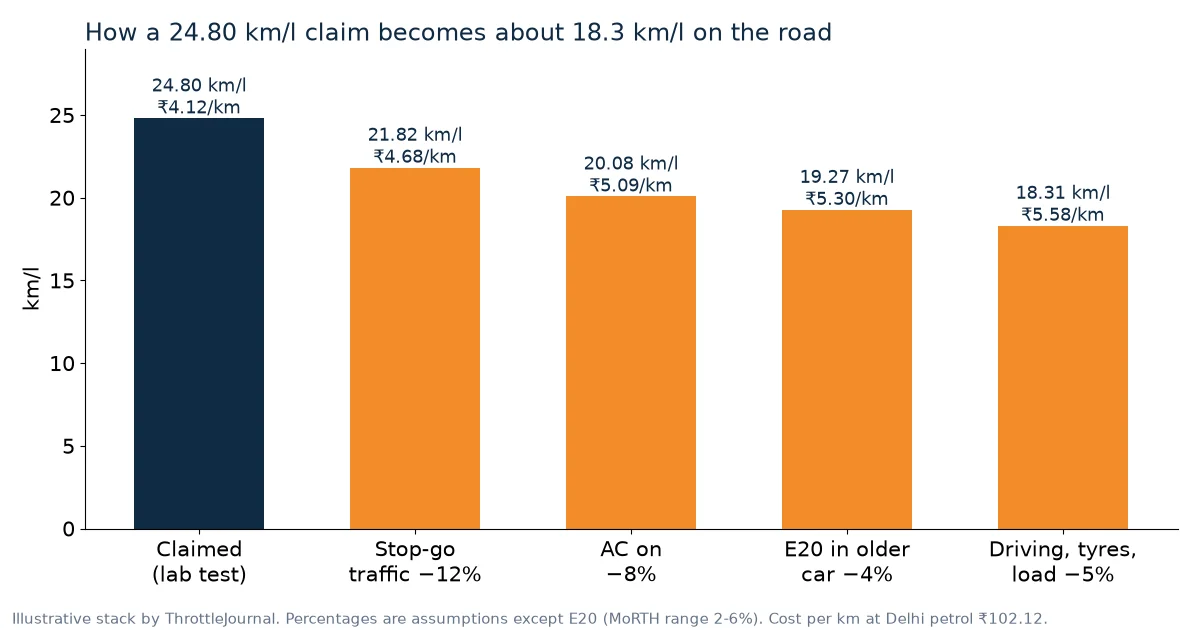
Think of the gap as a stack of separate losses that multiply together. Below, we start from the Maruti Swift petrol manual's claimed 24.80 km/l and apply four typical city losses. The percentages are ThrottleJournal assumptions for a car used mostly in metro traffic, except E20, where we use a figure inside the government's published range.
| Factor | Assumed loss | Calculation | Mileage after | Cost per km at ₹102.12 |
|---|---|---|---|---|
| Claimed (lab test) | — | — | 24.80 km/l | ₹4.12 |
| Stop-go traffic and idling | 12% | 24.80 × 0.88 | 21.82 km/l | ₹4.68 |
| AC running | 8% | 21.82 × 0.92 | 20.08 km/l | ₹5.09 |
| E20 petrol in an E10-designed car | 4% | 20.08 × 0.96 | 19.27 km/l | ₹5.30 |
| Driving style, tyres, load | 5% | 19.27 × 0.95 | 18.31 km/l | ₹5.58 |
Four modest-sounding losses add up to a 26.2% gap: (24.80 − 18.31) ÷ 24.80 = 0.262. That's why owners rarely see the brochure number even when nothing is wrong with the car.
1. Traffic and idling
Accelerating a tonne of car from standstill takes far more fuel than holding a steady speed, and an idling engine returns 0 km/l. The MIDC includes some stops, but nothing like a 40-minute crawl through a signal-heavy arterial road. This is the biggest single reason city figures trail highway figures.
2. Air-conditioning
The compressor is driven by the engine, so the AC costs fuel all the time it runs, and it costs relatively more in slow traffic, when the engine is doing little else. The current official test is done with the AC off, which is exactly why the government is changing it (more below).
3. Fuel: E20 petrol
Ethanol carries less energy per litre than petrol. ARAI and carmakers have acknowledged that E20 reduces fuel economy, with reported drops of 2% to 6% for vehicles designed for E10. Newer cars calibrated for E20 lose less. We used 4%, the middle of that range.
4. Driving style, tyres and load
Hard acceleration, high highway speeds, under-inflated tyres, a full boot and roof carriers all nibble at efficiency. None is dramatic alone, which is why 5% is a conservative combined figure for a typical owner.
Some things work in the other direction. A steady 60 to 80 km/h highway run with the windows up can get close to, or occasionally beat, the claimed number. That's one reason highway-heavy owners report much smaller gaps than city drivers.
What does the gap between claimed and real mileage cost you?
Here's the Swift example in rupees, assuming 1,200 km a month and Delhi petrol at ₹102.12 a litre (9 November 2026).
Budgeting with the claimed figure: 1,200 ÷ 24.80 = 48.4 litres a month. 48.4 × ₹102.12 = ₹4,941 a month.
Paying with the real figure: 1,200 ÷ 18.3 = 65.6 litres a month. 65.6 × ₹102.12 = ₹6,696 a month.
The difference: ₹6,696 − ₹4,941 = ₹1,755 a month, or ₹21,060 a year. Over five years of ownership, that's more than ₹1 lakh you wouldn't have planned for if you trusted the brochure.
The same logic applies to any car. The table below shows what each level of gap does to a car claimed at a round 20 km/l, driven 12,000 km a year.
| Gap vs claimed | Real mileage | Cost per km | Yearly fuel cost | Extra vs claimed |
|---|---|---|---|---|
| 0% (matches claim) | 20.0 km/l | ₹5.11 | ₹61,272 | — |
| 10% | 18.0 km/l | ₹5.67 | ₹68,080 | ₹6,808 |
| 20% | 16.0 km/l | ₹6.38 | ₹76,590 | ₹15,318 |
| 30% | 14.0 km/l | ₹7.29 | ₹87,531 | ₹26,259 |
| 40% | 12.0 km/l | ₹8.51 | ₹1,02,120 | ₹40,848 |
Notice that the cost doesn't rise in a straight line. Going from a 30% to a 40% gap costs ₹14,589 more a year, while going from 0% to 10% costs ₹6,808. That's because fuel use is distance divided by mileage: as mileage falls, each lost km/l costs more than the last.
How much lower than claimed mileage is normal?
Work out your own gap with one line of maths:
Gap % = (claimed − real) ÷ claimed × 100
If your Swift MT does 16.9 km/l on a tank-to-tank test, the gap is (24.80 − 16.9) ÷ 24.80 × 100 = 31.9%. Then compare it with these rough bands, which are ThrottleJournal rules of thumb rather than official standards:
- Under 15%: mostly highway or very light traffic. Excellent.
- 15% to 30%: normal for mixed or city driving with the AC on.
- 30% to 40%: heavy traffic, lots of short trips, or something worth checking.
- Over 40%: check tyre pressures, dragging brakes, the air filter and recent service history, then measure again.
A 31.9% gap in dense city traffic isn't necessarily a fault. But if the same car did 19 km/l last year on the same commute, a fall to 16.9 km/l (an 11% drop) is the signal to look for a cause.
Why do automatics often claim better mileage than manuals?
Look at the Swift: 24.80 km/l for the manual and 25.75 km/l for the AMT. Automated and automatic gearboxes are programmed to shift at the most efficient points of a test cycle every time, while a lab test of a manual follows prescribed shift points. On the road, an AMT keeps that consistency, but torque-converter automatics and CVTs in heavy traffic can lose more to creep and slippage. Treat a 1 km/l difference on paper as a tie in real life, and compare like with like by measuring your own car.
What changes with the new mileage test rules in 2027?
Two changes take effect from 1 April 2027, and both should narrow the gap you see on paper:
- AC-on testing. The road transport ministry has notified that new car models must be tested with the AC both on and off, and carmakers must publish both figures in the owner's manual and on their websites. Existing models are expected to get a few extra months to comply.
- WLTP-based testing. ARAI has upgraded its labs for AIS-175, which brings the global WLTP cycle with higher speeds and harder acceleration than the MIDC.
Expect claimed figures for the same car to fall when they're re-tested. That won't make cars any less efficient. It will just make the brochure number closer to what you'll actually see, which makes comparisons between cars and with EVs more honest.
Source: Times of India, 1 June 2026 (AC-on and AC-off testing for new models from April 2027).
How should you budget when you only have the claimed figure?
If you're comparing cars before buying, you won't have tank-to-tank data. A sensible approach:
- Take the claimed figure and knock off 25% for city use, or about 15% if most of your driving is highway. This is an assumption, but it matches the kind of gap the stack above produces.
- Use the same haircut for every car you compare, so the ranking stays fair.
- Price the result. Run the adjusted figure through our fuel cost calculator, and use the same discount when you weigh petrol against CNG or electric in our EV vs petrol vs diesel calculator.
For the Swift MT, 24.80 × 0.75 = 18.6 km/l, close to the 18.3 km/l our stack produced. Once you own the car, replace the estimate with your own measured figure.
Frequently asked questions
Is ARAI mileage wrong?
No. It's an accurate result for a specific lab test that every car takes in the same way. It's useful for comparing cars, not for predicting your fuel bill.
Can I complain if my car gives much less than the claimed mileage?
The brochure figure is a certified test result, not a promise for real roads, so a normal gap isn't grounds for a claim. A sudden drop on the same driving is a service issue worth raising with the dealer.
Why does my car give better mileage on the highway than claimed?
Steady speeds of 60 to 80 km/h with few stops can be more efficient than the stop-start portions of the lab cycle, so some cars match or beat the claim on a calm highway run.
Will E20 petrol hurt my mileage?
Slightly. Reported drops are 2% to 6% for cars designed for E10, and less for cars calibrated for E20.
Will the 2027 rules lower claimed mileage figures?
Very likely. AC-on results and a tougher WLTP-based cycle should both produce lower, more realistic numbers for new models.
Last updated: 9 November 2026. Fuel price is the New Delhi retail price on 9 November 2026. The loss percentages in the gap table, the 16.9 km/l and 19 km/l owner readings, the gap bands and the 25% budgeting haircut are ThrottleJournal assumptions for illustration. All mileage and cost figures are calculated by ThrottleJournal and rounded. This article is for information only.