 ThrottleJournal
How to Measure Real Mileage: The Tank-to-Tank Method, Done Properly
 By Chong Sem · Updated 9 November 2026
Short answer: to measure real mileage, fill the tank until the nozzle clicks off, reset the trip meter, drive at least half a tank, refill to the first click and divide the kilometres by the litres you just added. Do it for three tanks and divide total kilometres by total litres. In our worked log, 1,415 km on 103.7 litres gives a real figure of 13.65 km/l, which means every kilometre costs ₹7.48 in Delhi.
Most guides stop at the five steps. This one is about the part that decides whether your number is right: how big the measurement error is, how to shrink it, and how to average several tanks without fooling yourself. If you only want the division done for you, our mileage calculator handles it. If you want to know how to measure real mileage well enough to budget with, read on. The number feeds straight into our guide on how to calculate and cut your monthly fuel cost.
What is the tank-to-tank method for measuring mileage?
The tank-to-tank (or full-to-full) method uses the tank itself as a measuring jug. When you fill to the automatic click-off, the tank is at a repeatable "full" level. Drive, then fill back to that same level, and the litres the pump shows are exactly the fuel the engine burned over the distance on your trip meter. Nothing is estimated. That's why it beats both the brochure figure and the car's own display.
- Fill to the first click. Let the nozzle shut off by itself once. Don't round up to the next ₹100 and don't top up.
- Reset trip meter A. Photograph the odometer as well, in case the trip meter gets reset by someone else.
- Drive normally until the tank is at least half empty. Your usual mix of commute, errands and weekend driving.
- Refill to the first click, ideally at the same pump and the same nozzle, with the car parked the same way.
- Write down the litres and the trip distance before you leave the forecourt. Mileage (km/l) = distance ÷ litres.
The steps are simple. The quality of the answer depends on two things: how much fuel goes in at the second fill (more is better) and how consistently you stop at the click. Both are covered below.
Worked example: how do you calculate mileage over three tanks?
Here's a real-world style log for a petrol compact car used mostly in city traffic. We'll assume petrol at Delhi's price of ₹102.12 a litre (9 November 2026).
| Tank | Distance on trip meter | Litres to refill | Mileage for that tank | Mostly |
|---|---|---|---|---|
| 1 | 412 km | 31.2 L | 412 ÷ 31.2 = 13.21 km/l | City, peak hours |
| 2 | 538 km | 37.9 L | 538 ÷ 37.9 = 14.20 km/l | City plus one highway trip |
| 3 | 465 km | 34.6 L | 465 ÷ 34.6 = 13.44 km/l | City, monsoon traffic |
| Total | 1,415 km | 103.7 L | 13.65 km/l |
Step 1: add up the distance. 412 + 538 + 465 = 1,415 km.
Step 2: add up the fuel. 31.2 + 37.9 + 34.6 = 103.7 litres.
Step 3: divide. 1,415 ÷ 103.7 = 13.65 km/l.
Step 4: cost per km. ₹102.12 ÷ 13.65 = ₹7.48 per km.
Step 5: monthly cost. At 1,200 km a month, you burn 1,200 ÷ 13.65 = 87.9 litres, and 87.9 × ₹102.12 = ₹8,981 a month.
Price: Times of India, petrol price in New Delhi (₹102.12 a litre, 9 November 2026).
Don't average the three mileage figures
It's tempting to add 13.21, 14.20 and 13.44 and divide by three. That gives 13.61 km/l, which is slightly wrong. Each tank covered a different distance, so a simple average gives a short tank the same weight as a long one. Total kilometres ÷ total litres is the only figure that matches what you actually spent at the pump. The gap here is small, 0.04 km/l, but it grows when one tank is a long highway run and the others are short city tanks.
How accurate is the tank-to-tank method?
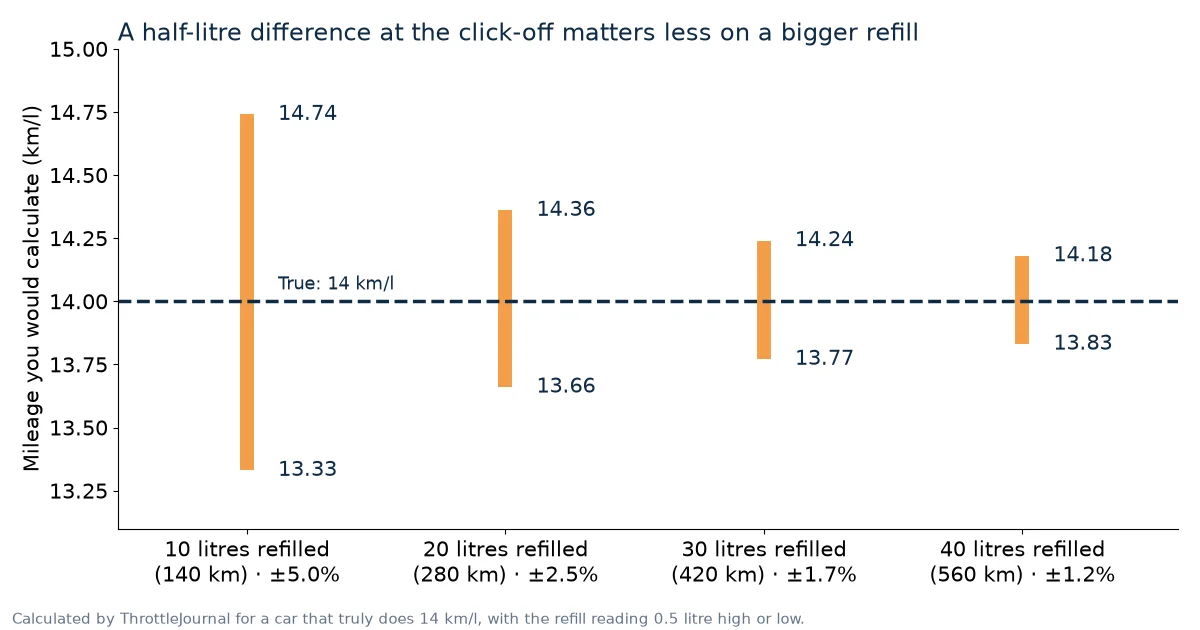
Accurate enough to budget with, if you respect its one weakness: the "full" level is never exactly the same twice. Where the nozzle clicks depends on the pump's flow rate, how the nozzle sits in the filler neck, foam in the fuel and whether the car is level. In practice the second fill can land half a litre above or below the first one.
That half-litre is a fixed error, so its effect depends on how much you put in. Here's what it does to a car that truly returns 14 km/l:
| Litres refilled | Distance driven | If refill reads 0.5 L high | If refill reads 0.5 L low | Possible error |
|---|---|---|---|---|
| 10 L | 140 km | 13.33 km/l | 14.74 km/l | ±5.0% |
| 20 L | 280 km | 13.66 km/l | 14.36 km/l | ±2.5% |
| 30 L | 420 km | 13.77 km/l | 14.24 km/l | ±1.7% |
| 40 L | 560 km | 13.83 km/l | 14.18 km/l | ±1.2% |
The maths for the first row: 140 km ÷ (10 + 0.5) L = 13.33 km/l, and 140 km ÷ (10 − 0.5) L = 14.74 km/l. A 10-litre "test" can tell you anything between 13.3 and 14.7, which is useless for comparing a tyre-pressure change or a new driving habit. At 40 litres, the same sloppiness moves the answer by less than 0.2 km/l.
Four ways to cut the error
- Refill more fuel. Drive until the tank is at least half empty. On a 37-litre tank, that's around 20 litres or more.
- Use the same pump and nozzle. Flow rates differ between dispensers, and a faster flow tends to click off earlier.
- Park the same way. A slope on the forecourt changes how much air is trapped in the filler neck.
- Stop at the first click, every time. Topping up after the click is the single biggest source of inconsistent readings, and it can also push fuel into the evaporative system.
What about the pump and the odometer?
The pump itself is a smaller worry than most people think. Fuel stations must keep a stamped 5-litre measure on site and check their dispensers every day, and a dispenser that passes inspection can be out by about 25 ml in every 5 litres, or 0.5%. If you doubt a pump, you can ask for the 5-litre test.
Source: Delhi Legal Metrology (Enforcement) Rules, 2011 (dealers must keep a verified 5-litre measure and check delivery daily).
The odometer is a different matter. Speedometers are commonly set to read slightly high, and the odometer can drift too, especially after a change to a different tyre size. As an illustration, if your odometer over-reads by 3% (an assumption, not a measured figure), 13.65 km/l on the trip meter is really 13.65 × 0.97 = 13.24 km/l. To check yours, drive a known stretch, such as 10 km between highway kilometre stones, and compare it with the trip meter.
What if you don't fill up to full every time?
Plenty of people buy ₹500 or ₹1,000 of fuel at a time. You can still measure real mileage. The rule is: the measurement runs from one full tank to the next full tank, and you count every litre bought in between.
Example. You fill to the click and reset the trip meter. Over the next fortnight you buy 15.0 litres and then 20.0 litres. The next time you fill to the click it takes 18.4 litres, and the trip meter reads 742 km.
Mileage = 742 ÷ (15.0 + 20.0 + 18.4) = 742 ÷ 53.4 = 13.90 km/l.
Keep the fuel receipts or note each fill in your phone. If you miss one partial fill, the whole calculation is wrong, so start again from the next full tank.
Why doesn't my trip computer match my tank-to-tank mileage?
The average fuel economy on your dashboard is calculated from how long the injectors stay open, not from fuel actually leaving the tank. It's a useful trend line, but many owners find it reads on the optimistic side, and it resets whenever someone presses the button.
Here's why the difference matters. Say the display in our example car shows 15.1 km/l while the tank-to-tank figure is 13.65 km/l:
- Budgeting with the display: 1,200 ÷ 15.1 × ₹102.12 = ₹8,115 a month
- Budgeting with the tank: 1,200 ÷ 13.65 × ₹102.12 = ₹8,981 a month
- Gap: ₹866 a month, or about ₹10,400 a year you didn't plan for
Once you have one solid tank-to-tank figure, you can work out how far off your display is (here, 15.1 ÷ 13.65 = 1.106, so about 11% high) and mentally correct it from then on.
How many tanks do you need for a reliable mileage figure?
Three is the practical minimum, for three reasons:
- Driving varies. One tank with a long highway trip can flatter the figure by a full km/l or more, as tank 2 in our log shows.
- Click-off error averages out. Over 100-plus litres, a half-litre slip is worth well under 1%.
- You catch mistakes. If one tank is wildly different from the other two, you probably missed a fill or a partial top-up.
Repeat the exercise once in summer and once in winter if you can. AC use in May and short, cold-start trips in a north Indian January both pull the number down. Fuel matters too: India's roads ministry told the Lok Sabha in July 2026 that cars designed for E10 petrol may lose 2% to 6% in fuel efficiency on E20. If your car is older and your mileage has slipped by a few percent since the switch, that's within the expected range rather than a fault.
Source: The Economic Times, 31 July 2026 (road ministry: 2% to 6% efficiency drop on E20 for E10-designed vehicles).
Does the tank-to-tank method work for CNG and electric cars?
CNG: yes, with kilograms instead of litres. CNG dispensers show the kg delivered. The "full" point depends on cylinder pressure and gas temperature, which vary more than a petrol click-off, so the error is larger. Run at least three fills and use total km ÷ total kg. Bi-fuel cars start on petrol, so short trips burn a little petrol too. Note any petrol you add during the test.
Electric: the equivalent is charge-to-charge, using units (kWh) from your home charger's app or a dedicated meter. Charge to the same percentage each time and divide kilometres by the kWh drawn from the wall. That figure includes charging losses, which is what you actually pay for. The car's own kWh/100 km display usually leaves those losses out.
What should you do with your real mileage figure?
- Know why it differs from the brochure. Our guide to claimed vs real-world mileage breaks down the gap and tells you how big a shortfall is normal.
- Budget with it. Plug your real km/l into our fuel cost calculator for trip, monthly and yearly costs, and use it in any EV-versus-petrol comparison instead of the brochure figure.
- Set a baseline for problems. A sustained drop of 10% or more on similar driving is worth investigating: tyre pressures first, then air filter and spark plugs at the next service.
- Test one change at a time. If you want to know whether smoother driving or correct tyre pressure helps, change one thing and log two full tanks. With refills of 30 litres or more, a 3% to 5% improvement shows up clearly above the measuring error.
Frequently asked questions
How many kilometres should I drive before measuring mileage?
Enough to need at least 20 litres to refill, which is usually 250 to 400 km in a petrol hatchback. Below about 10 litres, a half-litre click-off difference can swing the result by 5%.
Should I fill to the brim for a more accurate reading?
No. Stop at the first automatic click both times. Squeezing in extra fuel is less repeatable than the click, so it adds error rather than removing it.
Why is my first tank-to-tank reading so different from the second?
Usually because the driving was different, such as a highway trip in one tank, or the fill level wasn't the same. That's why you average total kilometres over total litres across at least three tanks.
Is the trip computer or the tank-to-tank figure correct?
The tank-to-tank figure, because it measures fuel you actually paid for. Use the display for trends, and correct it by the gap you find between the two.
Can I use the odometer instead of the trip meter?
Yes. Note the odometer at the first full fill and again at the second, and subtract. It's the same distance, just with one more step.
Last updated: 9 November 2026. Fuel price is the New Delhi retail price on 9 November 2026 and changes often. The three-tank log, the 15.1 km/l trip-computer reading and the 3% odometer error are illustrative assumptions used to show the method; all mileage, cost and error figures are calculated by ThrottleJournal and rounded. This article is for information only.