 ThrottleJournal
Flat Rate vs Reducing Balance Car Loans: What You Really Pay
 By Chong Sem · Updated 8 November 2026
Short answer: a flat rate charges interest on the full original loan for the whole tenure, while a reducing balance rate charges interest only on what you still owe. That makes a flat rate roughly 1.8 times more expensive than it looks: a 5% flat rate on a 3-year car loan is really 9.31% on a reducing balance. Always convert a flat quote before you compare it with a bank's rate.
The flat rate vs reducing balance car loan question matters because the two numbers look alike but aren't. A "5%" flat quote from a showroom finance desk can sound far cheaper than a bank's 9%, when in fact it costs more. Our car loan guide flags the trap with one example. Here we go further: a conversion table you can use on any quote, the shortcut to estimate it in your head, the exact way to calculate it, and what India's Key Facts Statement rules mean for you.
What is the difference between flat rate and reducing balance?
Both methods produce a fixed monthly EMI. The difference is what the interest is charged on.
- Flat rate: interest = original loan × flat rate × years. That total is added to the loan and divided equally over the months. You keep paying interest on money you've already repaid.
- Reducing balance: each month's interest = the balance you still owe × monthly rate. As you repay, the interest shrinks. This is the method banks use for car loans, and the one behind the standard EMI formula.
Flat EMI = (P + P × flat rate × years) ÷ months
On a reducing balance loan, you've paid back about half the principal by roughly the middle of the tenure, so on average you're only borrowing about half the original amount. A flat rate ignores that and charges you as if you'd borrowed the full sum the whole time. That's the entire trick.
Worked example: ₹6 lakh at 5% flat vs 9% reducing
Say you're borrowing ₹6 lakh for 3 years (36 months). The showroom quotes 5% flat. Your bank quotes 9% on a reducing balance.
Flat rate quote
- Interest = ₹6,00,000 × 5% × 3 = ₹90,000
- EMI = (₹6,00,000 + ₹90,000) ÷ 36 = ₹19,167
Reducing balance quote
- Monthly rate = 9 ÷ 1,200 = 0.0075; (1.0075)36 = 1.3086
- EMI = 6,00,000 × 0.0075 × 1.3086 ÷ 0.3086 = ₹19,080
- Total interest = ₹19,080 × 36 − ₹6,00,000 = ₹86,874
| 5% flat | 9% reducing | |
|---|---|---|
| Monthly EMI | ₹19,167 | ₹19,080 |
| Total interest | ₹90,000 | ₹86,874 |
| Total repaid | ₹6,90,000 | ₹6,86,874 |
| Real reducing-balance rate | 9.31% | 9.00% |
The "5%" loan costs ₹3,126 more, even though its headline rate is barely more than half the bank's. Its true rate on a reducing balance is 9.31%.
Here's another way to see it. On the flat loan, the interest is fixed at ₹2,500 a month (₹90,000 ÷ 36) from the first EMI to the last. In the 36th month you owe the lender only about ₹19,000, yet you're still being charged ₹2,500 of interest on it, which is more than 13% of the balance for a single month.
Flat rate to reducing balance conversion table
We calculated the equivalent reducing-balance rate for common flat quotes and tenures. Find your flat rate and tenure to see what you're really paying.
| Flat rate quoted | 3 years | 5 years | 7 years |
|---|---|---|---|
| 4% | 7.51% | 7.42% | 7.30% |
| 5% | 9.31% | 9.15% | 8.97% |
| 6% | 11.08% | 10.85% | 10.58% |
| 7% | 12.83% | 12.50% | 12.16% |
| 8% | 14.55% | 14.13% | 13.69% |
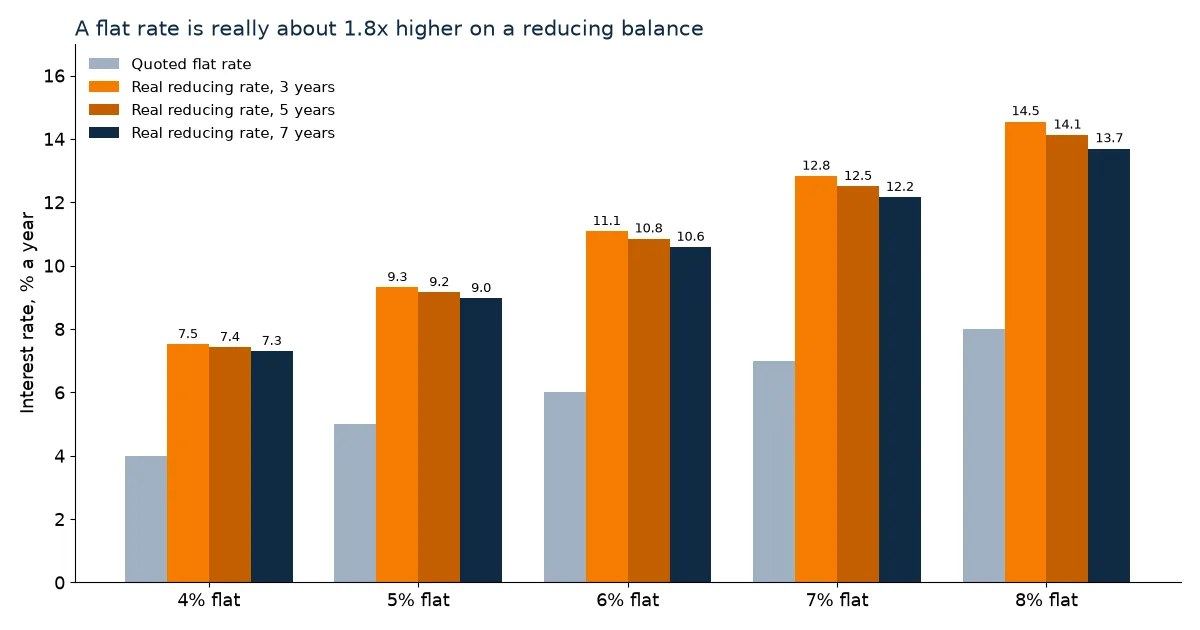
To put that in context, Bank of Baroda lists new-car floating rates of 7.85% to 11.55% (effective 8 October 2026). A 6% flat quote, at 10.6% to 11.1% equivalent, sits near the top of that range. A 4% flat quote, at about 7.3% to 7.5%, would genuinely be competitive. Going the other way, a 9% reducing-balance loan is the same as about 4.8% flat over 3 years and 5.0% flat over 7 years.
Is there a quick way to convert flat rate to reducing?
Yes. Multiply the flat rate by about 1.8 for a typical 3 to 7 year car loan. A 5% flat quote × 1.8 = 9%, close to the exact 9.0% to 9.3% in the table.
You'll often see a "multiply by 2" rule. That's based on the idea that your average balance is half the loan, so a flat rate is "double". It overstates the gap slightly, because the balance on a reducing loan falls slowly at first (early EMIs are mostly interest) and quickly at the end, so your average balance is a bit more than half. The table shows the real multiplier is about 1.86 at 3 years, 1.83 at 5 years and 1.79 at 7 years.
Notice something counter-intuitive in the table: the equivalent rate falls slightly as the tenure grows. That doesn't make long flat-rate loans a good deal. The total interest still rises steeply with tenure, because the flat interest is charged on the full loan for every extra year. On ₹8 lakh at 5% flat, 5 years costs ₹2,00,000 in interest; at 7 years it's ₹2,80,000.
How do you convert a flat rate to a reducing rate exactly?
There's no simple algebraic formula, because the reducing rate is buried inside the EMI formula. But a spreadsheet solves it in one step with the RATE function:
=RATE(months, −EMI, loan) × 12
Using the 5% flat quote on ₹8 lakh over 5 years:
- Flat interest = ₹8,00,000 × 5% × 5 = ₹2,00,000
- Flat EMI = (₹8,00,000 + ₹2,00,000) ÷ 60 = ₹16,667
=RATE(60, -16667, 800000) * 12→ 9.15%
Compare that with an 8.8% reducing-balance loan on the same ₹8 lakh, which has an EMI of ₹16,529. The flat loan costs ₹138 more every month, or ₹8,252 over 5 years.
No spreadsheet? Use our EMI calculator: enter the loan and tenure, then change the rate until the EMI matches the flat EMI you were quoted. The rate that matches is the real one.
Rate range: Bank of Baroda retail loan interest rates, BRLLR-linked rates effective 8 October 2026. Equivalent rates calculated by ThrottleJournal.
How does the RBI's Key Facts Statement help you compare?
Since 1 October 2024, every bank and NBFC in India must give retail borrowers a Key Facts Statement (KFS) before the loan contract is signed. Under the RBI's April 2024 circular, the KFS must include:
- the Annual Percentage Rate (APR), which the RBI defines as "the annual cost of credit to the borrower which includes interest rate and all other charges";
- a computation sheet showing how the APR was worked out;
- the full amortisation (repayment) schedule;
- third-party charges collected by the lender, such as insurance, which also count towards the APR.
The KFS also has to stay valid for at least three working days, so you have time to compare. And fees not listed in it can't be charged later without your explicit consent.
For flat-rate quotes, the APR is the number that cuts through. Because it's an annualised cost on the money you actually owe, a 5% flat loan with fees will show an APR above 9%, which you can line up directly against a bank's APR. If a lender or dealer can't show you a KFS with the APR, treat that as a warning sign.
Source: RBI circular "Key Facts Statement (KFS) for Loans & Advances", 15 April 2024.
What happens if you prepay a flat-rate loan?
This is the second, less obvious cost. On a reducing balance loan, prepaying cuts your balance and future interest falls automatically. On a flat-rate loan, the total interest was fixed at the start, so what you save on foreclosure depends entirely on how the lender calculates the interest it gives back, plus any foreclosure charge.
Before signing a flat-rate loan, ask in writing:
- If I close the loan after 12 or 24 months, what is the exact payoff amount?
- How is unearned interest rebated?
- What foreclosure or part-prepayment charge applies, and until when?
Compare those answers with a bank loan. Bank of Baroda, for instance, lists no foreclosure charges on its floating-rate car loan option (Bank of Baroda car loan page), which means every rupee you prepay stops attracting interest straight away.
Is a flat rate ever the better deal?
Only when the flat rate is low enough that its equivalent reducing rate beats the alternatives once fees are included. Use the table or the 1.8x rule:
- A flat quote below roughly 4.2% to 4.3% (depending on tenure) generally beats a 7.85% reducing rate (the lowest new-car rate in Bank of Baroda's current range).
- A flat quote of 5% is roughly equal to a 9% to 9.3% reducing rate. Choose on fees, prepayment terms and discounts.
- A flat quote of 6% or more is more expensive than most bank car loans for borrowers with a good credit score.
Dealer offers also bundle other things, such as insurance and discounts that change the real cost. We put numbers on those in bank vs dealer financing.
Frequently asked questions
Is 6% flat rate good for a car loan?
Not usually. A 6% flat rate equals about 10.85% on a reducing balance over 5 years, which is higher than most banks charge new-car borrowers with good credit.
Do banks in India charge flat rates on car loans?
Mainstream banks quote car loans on a reducing balance; Bank of Baroda, for example, calculates interest on the daily reducing balance. Flat quotes are more likely from some finance desks and lenders for used vehicles. Ask "flat or reducing?" every time.
How do I convert a flat rate to a reducing rate without Excel?
Multiply by 1.8 for a quick estimate. For an exact answer, use an EMI calculator and adjust the rate until the EMI matches the flat EMI.
Why is my EMI almost the same on both quotes?
Because a flat rate that's about half the reducing rate produces a similar EMI. That's exactly why the flat number looks attractive. Compare the EMIs and the APR, not the headline rates.
Last updated: 8 November 2026. Rate range as published by Bank of Baroda, effective 8 October 2026, and may have changed. All EMI and equivalent-rate figures are calculated by ThrottleJournal. This article is for information only and isn't financial advice.