 ThrottleJournal
How Car Loan EMI Is Calculated, With a Worked Example
 By Chong Sem · Updated 8 November 2026
Short answer: your car loan EMI is calculated with one formula, EMI = P × r × (1 + r)n ÷ [(1 + r)n − 1], where P is the loan, r is the monthly rate and n is the number of months. A ₹6 lakh loan at 9% for 4 years works out to an EMI of ₹14,931, and ₹1,16,689 of interest in total. Below, we work through that example by hand, line by line, so you can check any bank's number yourself.
Our complete car loan guide covers rates, tenure and down payment. This article zooms in on one question: how is car loan EMI calculated, and why the number on your sanction letter sometimes differs by a few rupees, or a few thousand, from what an online calculator shows. If you just want the number, use our car loan EMI calculator. If you want to understand it, read on.
What is the formula for car loan EMI?
Indian banks use the reducing balance method for car loans. Each month you pay interest only on the amount you still owe, and the rest of the EMI repays principal. Bank of Baroda, for example, states on its car loan page that interest "is calculated on the daily reducing balance". The Reserve Bank of India defines an EMI as a fixed instalment of principal and interest that "result[s] in complete amortisation of the loan" over a fixed number of payments.
The formula that produces that fixed amount is:
EMI = P × r × (1 + r)n ÷ [(1 + r)n − 1]
- P (principal): the amount you borrow, not the car's price. If the on-road price is ₹7.5 lakh and you pay ₹1.5 lakh down, P is ₹6,00,000.
- r (monthly rate): the annual rate divided by 12 and then by 100. At 9% a year, r = 9 ÷ 1,200 = 0.0075.
- n (months): the tenure in months. Four years is 48.
The part in brackets is what makes the payments equal. (1 + r)n is how much ₹1 would grow to at the loan's rate over the full tenure. The formula finds the single monthly payment that exactly pays off P plus all the interest that builds up on the falling balance, with nothing left at the end.
Sources: Bank of Baroda car loan page (interest on daily reducing balance, tenure up to 84 months) and RBI circular on Key Facts Statement for loans, 15 April 2024 (definition of EMI).
Worked example: ₹6 lakh car loan at 9% for 4 years
Let's say you're buying a compact SUV with an on-road price of ₹7.5 lakh, paying ₹1.5 lakh down and borrowing ₹6 lakh. We'll assume a rate of 9% a year, which sits inside the 7.85% to 11.55% range Bank of Baroda currently lists for new-car floating-rate loans (effective 8 October 2026). Your actual rate depends on your credit profile.
Step 1: monthly rate. r = 9 ÷ 12 ÷ 100 = 0.0075
Step 2: the growth factor. (1 + r)n = 1.007548 = 1.431405
Step 3: top of the formula. P × r × (1 + r)n = 6,00,000 × 0.0075 × 1.431405 = 6,441.32
Step 4: bottom of the formula. (1 + r)n − 1 = 0.431405
Step 5: divide. EMI = 6,441.32 ÷ 0.431405 = ₹14,931 (₹14,931.03 before rounding)
Step 6: totals. You pay ₹14,931.03 × 48 = ₹7,16,689 over the loan. Subtract the ₹6,00,000 you borrowed and the total interest is ₹1,16,689.
That's the whole calculation. Every bank, calculator and spreadsheet that uses the reducing balance method will land on the same EMI to within a rupee or two, as long as P, the rate and the tenure are the same.
How is each EMI split between interest and principal?
The EMI stays the same every month, but what it pays for changes. Interest for any month = outstanding balance × r. Whatever is left of the EMI reduces the balance.
| EMI no. | Balance at start | Interest (balance × 0.0075) | Principal (EMI − interest) | Balance after EMI |
|---|---|---|---|---|
| 1 | ₹6,00,000 | ₹4,500 | ₹10,431 | ₹5,89,569 |
| 2 | ₹5,89,569 | ₹4,422 | ₹10,509 | ₹5,79,060 |
| 3 | ₹5,79,060 | ₹4,343 | ₹10,588 | ₹5,68,472 |
Each month the interest falls by about ₹80 and the principal portion rises by the same amount. By the 48th EMI, only ₹111 is interest and ₹14,820 is principal. The chart below shows all 48 payments.
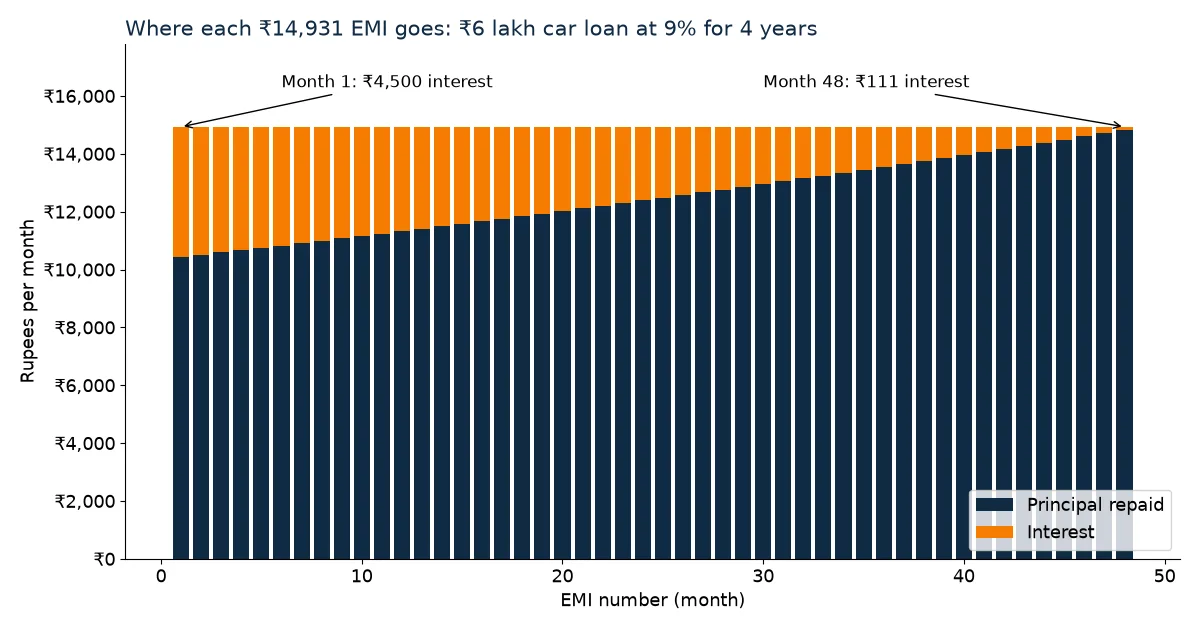
Added up by year, the pattern is clear:
| Year | EMIs paid | Interest | Principal repaid | Balance at year end |
|---|---|---|---|---|
| 1 | ₹1,79,172 | ₹48,705 | ₹1,30,467 | ₹4,69,533 |
| 2 | ₹1,79,172 | ₹36,467 | ₹1,42,706 | ₹3,26,827 |
| 3 | ₹1,79,172 | ₹23,080 | ₹1,56,092 | ₹1,70,735 |
| 4 | ₹1,79,172 | ₹8,437 | ₹1,70,735 | ₹0 |
| Total | ₹7,16,689 | ₹1,16,689 | ₹6,00,000 |
Two practical points follow. First, 42% of all the interest (₹48,705 of ₹1,16,689) is paid in year 1. That's why a part-prepayment early in the loan saves more than the same amount later. Second, if you sell the car after two years, you'll need ₹3,26,827 to close the loan, not "half of ₹6 lakh". Keep that in mind when you compare it with the car's resale value; our guide to the true cost of owning a car shows how fast that value falls.
What is the EMI per ₹1 lakh of car loan?
Because the formula is proportional to P, the EMI for ₹1 lakh tells you the EMI for any amount. Multiply the figure below by your loan in lakh. For ₹6 lakh at 9% over 48 months: ₹2,489 × 6 = ₹14,934, within a few rupees of the exact ₹14,931 (the small gap is rounding in the table).
| Rate (p.a.) | 3 years | 4 years | 5 years | 6 years | 7 years |
|---|---|---|---|---|---|
| 8.0% | ₹3,134 | ₹2,441 | ₹2,028 | ₹1,753 | ₹1,559 |
| 8.5% | ₹3,157 | ₹2,465 | ₹2,052 | ₹1,778 | ₹1,584 |
| 9.0% | ₹3,180 | ₹2,489 | ₹2,076 | ₹1,803 | ₹1,609 |
| 9.5% | ₹3,203 | ₹2,512 | ₹2,100 | ₹1,827 | ₹1,634 |
| 10.0% | ₹3,227 | ₹2,536 | ₹2,125 | ₹1,853 | ₹1,660 |
| 11.0% | ₹3,274 | ₹2,585 | ₹2,174 | ₹1,903 | ₹1,712 |
Read across a row and you'll see that stretching from 4 to 7 years cuts the EMI by roughly a third. Read down a column and you'll see that each extra percentage point of interest adds only about ₹45 to ₹50 per lakh per month. A rate change feels small month to month; it adds up over the tenure, which our article on how your credit score changes your car loan rate quantifies.
How do you calculate car loan EMI in Excel?
Excel and Google Sheets both have the formula built in as PMT:
=PMT(9%/12, 48, -600000) → 14,931.03
- The first argument is the monthly rate (annual rate ÷ 12).
- The second is the number of months.
- The third is the loan amount, entered as a negative number so the EMI shows as positive.
To build a full repayment schedule, put the opening balance in one column, interest as =balance*9%/12 in the next, principal as =EMI-interest, and closing balance as =balance-principal. Copy the row down 48 times. The last closing balance should be zero (or a fraction of a rupee). If it isn't, one of your inputs is off.
The same spreadsheet is handy for checking a loan offer: since October 2024, the RBI requires lenders to give retail borrowers a Key Facts Statement that includes the loan's amortisation schedule. You can rebuild that schedule yourself and confirm it matches.
How much car loan can a given EMI support?
Often the real question is the other way round: "I can afford ₹15,000 a month. How much can I borrow?" Rearrange the formula:
Loan = EMI × [1 − (1 + r)−n] ÷ r
At 9% for 48 months: 15,000 × (1 − 1.0075−48) ÷ 0.0075 = ₹6,02,772. So a ₹15,000 budget supports a loan of about ₹6 lakh over 4 years. Add your down payment and you have the most on-road price you should be looking at. The EMI is only part of the monthly cost, though; our guide on buying the right car for your budget adds fuel, insurance and servicing on top.
Why doesn't my bank's EMI match the calculator?
If the bank's figure is within a rupee or two of yours, that's rounding. If it's further off, one of these is usually the reason:
1. The loan amount isn't what you think
Processing fees, insurance or an extended warranty are sometimes added to the loan rather than paid upfront. A ₹20,000 insurance premium rolled into the loan raises P to ₹6.2 lakh and the EMI to about ₹15,429. Check the sanctioned amount on the Key Facts Statement, not the car's price.
2. Broken-period interest
Your loan is disbursed on one date, but EMIs fall on a fixed date each month. Interest for the gap is charged separately as "broken-period" or "pre-EMI" interest, or adjusted into the first EMI. For example, if ₹6 lakh is disbursed 23 days before your EMI cycle begins, the extra interest at 9% is 6,00,000 × 9% × 23 ÷ 365 = ₹3,403. It's a one-off, but it explains why the first deduction can look odd. Ask how your lender handles it.
3. Daily vs monthly interest
Some banks, including Bank of Baroda, calculate interest on the daily reducing balance. Months with 31 days then carry slightly more interest than months with 30, so the exact interest/principal split in your statement can differ from a monthly schedule by small amounts, even though the EMI is the same.
4. The rate is flat, not reducing
If the gap is large, say several hundred rupees a month, check whether the quote was a flat rate. A flat rate charges interest on the original loan for the whole tenure. A 5% flat rate on ₹6 lakh for 3 years gives an EMI of ₹19,167, more than a 9% reducing-balance loan (₹19,080). We break this down in flat rate vs reducing balance car loans.
5. EMIs paid in advance
Some dealer-arranged schemes collect one or more EMIs upfront. The EMI is the same as the formula gives, but you effectively borrow less for the same payments, which pushes up the real rate. Our comparison of bank vs dealer financing shows the rupee impact.
6. The floating rate changed
On a floating-rate loan linked to the repo rate, a rate reset changes the EMI or, at many banks, the number of EMIs left. After the RBI's 0.25 percentage point repo rate rise in October 2026, a reset from 9% to 9.25% on a fresh ₹6 lakh, 4-year loan would raise the EMI by about ₹71 (from ₹14,931 to ₹15,002), if the bank keeps the tenure fixed.
Quick checklist: verify your EMI in 5 minutes
- Note the sanctioned loan amount, rate (and whether it's reducing balance) and number of EMIs from your Key Facts Statement.
- Run them through
=PMT(rate/12, months, -loan)or our EMI calculator. - If the result differs by more than a few rupees, ask the lender which of the six reasons above applies.
- Multiply the EMI by the number of months, subtract the loan, and write down the total interest. That's the figure to compare between offers, together with fees.
Frequently asked questions
How is EMI calculated on a car loan of ₹5 lakh?
Use the per-lakh table above and multiply by 5. At 9% over 5 years, the EMI is ₹2,076 × 5 = about ₹10,379 a month (₹10,379.18 exactly by the formula), with total interest of about ₹1,22,751.
Does the EMI change if I prepay part of the loan?
Usually the EMI stays the same and the tenure shortens, which saves the most interest. Some banks let you choose a lower EMI instead. Either way, the formula is simply re-run on the new, lower balance.
Is the interest rate in the EMI formula the same as the APR?
No. The formula uses the loan's interest rate. The Annual Percentage Rate on your Key Facts Statement also includes fees and other charges, so it's slightly higher and is the better number for comparing lenders.
Why is so much of my early EMI going to interest?
Because interest is charged on the balance, which is highest at the start. On our ₹6 lakh example, the first EMI is 30% interest (₹4,500 of ₹14,931); the last is under 1%.
Last updated: 8 November 2026. Rate ranges are as published by Bank of Baroda (effective 8 October 2026) and may have changed. All EMI, interest and balance figures are calculated by ThrottleJournal with the standard reducing balance formula and rounded to the nearest rupee. This article is for information only and isn't financial advice.