 ThrottleJournal
Manual vs Automatic Mileage: Which Really Saves More Fuel in India?
 By Chong Sem · Updated 9 November 2026
Short answer: on manual vs automatic mileage, modern petrol automatics (AMT, CVT and DCT) now match or beat their manual twins on paper, while the diesel torque-converter automatics we checked claim 12% to 15% less. Either way, the fuel difference is small next to the price gap: a Venue turbo DCT saves about ₹412 a month over the manual but costs ₹90,000 more, so it takes about 18 years to pay back on fuel alone.
The old rule was simple: automatics drink more fuel. That's no longer true for many Indian cars, but it isn't false either. It depends on the type of gearbox, the engine it's paired with and how you drive. This guide compares the official figures for popular manual and automatic pairs, turns the differences into rupees, and explains when an automatic makes financial sense. To check your own car's figure, use our tank-to-tank mileage method.
What types of automatic gearbox are sold in India?
"Automatic" covers four very different technologies, and they don't behave the same way on fuel.
| Type | How it works | Typical in | Effect on claimed mileage |
|---|---|---|---|
| AMT (automated manual) | A regular manual gearbox with a robot doing the clutch and shifts | Budget hatchbacks and compact cars | Usually the same as or slightly better than the manual |
| CVT / iVT | Belt-and-pulley system with no fixed gears | Petrol hatchbacks, sedans and SUVs | Often close to or slightly better than the manual |
| DCT (dual-clutch) | Two clutches pre-select the next gear for quick shifts | Turbo-petrol cars | Often better than the manual |
| Torque converter | Fluid coupling with planetary gears | Diesel and larger cars | Usually worse than the manual |
AMTs and DCTs are mechanically close to manuals, so they lose little energy, and their computers shift at the most efficient points every time. Torque converters lose some energy through the fluid coupling, especially at low speeds, which is why they're usually the thirstiest option.
Manual vs automatic: what do the official mileage figures say?
Here are the certified figures for five popular manual-automatic pairs, each using the same engine.
| Car and engine | Manual | Automatic (type) | Difference |
|---|---|---|---|
| Maruti Swift 1.2 petrol | 24.80 km/l | 25.75 km/l (AMT) | +3.8% |
| Hyundai Creta 1.5 petrol | 17.4 km/l | 17.7 km/l (iVT) | +1.7% |
| Hyundai Venue 1.0 turbo petrol | 18.74 km/l | 20.00 km/l (DCT) | +6.7% |
| Hyundai Creta 1.5 diesel | 21.8 km/l | 19.1 km/l (torque converter) | −12.4% |
| Hyundai Venue 1.5 diesel | 20.99 km/l | 17.9 km/l (torque converter) | −14.7% |
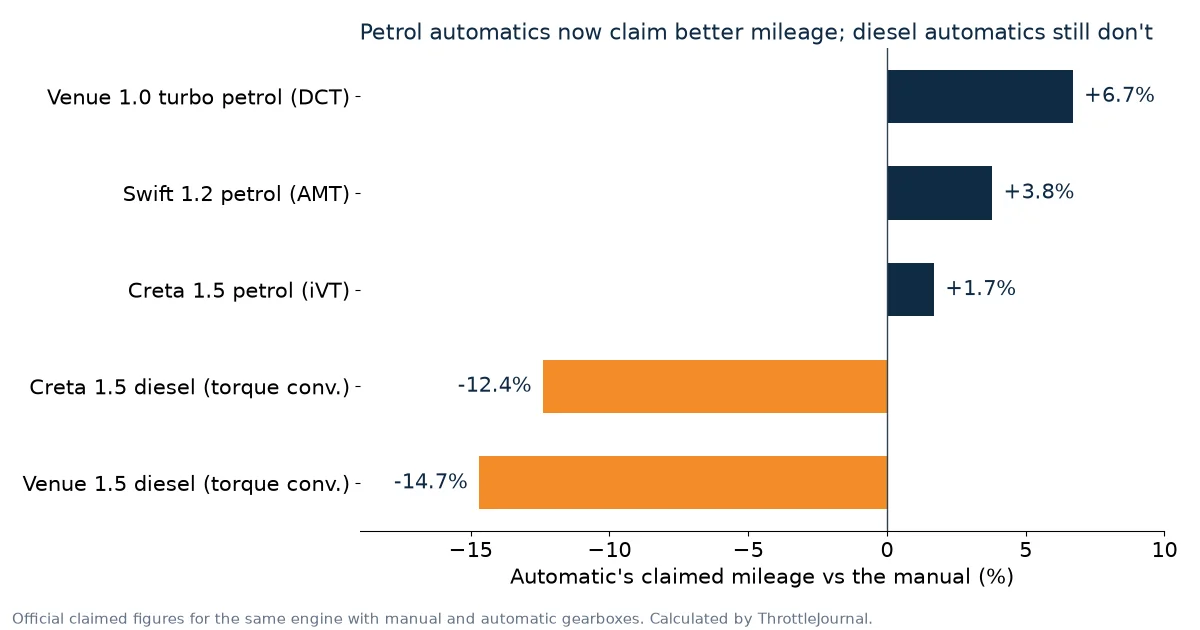
The pattern is clear. All three petrol automatics claim better mileage than their manuals, by 1.7% to 6.7%. Both diesel torque-converter automatics claim 12% to 15% worse.
Sources: Maruti Suzuki Swift official page; Times Now, 22 June 2026 (Creta); Autocar India, Hyundai Venue (Venue).
How much is the manual vs automatic mileage difference worth in rupees?
Percentages look dramatic; rupees put them in perspective. At 1,200 km a month, with Delhi petrol at ₹102.12 and diesel at ₹95.20 a litre (9 November 2026), using the claimed figures:
| Car | Manual a month | Automatic a month | Automatic saves (costs) | Per year |
|---|---|---|---|---|
| Swift petrol (AMT) | ₹4,941 | ₹4,759 | ₹182 | ₹2,188 |
| Creta petrol (iVT) | ₹7,043 | ₹6,923 | ₹119 | ₹1,432 |
| Venue turbo petrol (DCT) | ₹6,539 | ₹6,127 | ₹412 | ₹4,944 |
| Creta diesel (TC) | ₹5,240 | ₹5,981 | (₹741) | (₹8,889) |
| Venue diesel (TC) | ₹5,443 | ₹6,382 | (₹940) | (₹11,274) |
How the Venue DCT row works: 1,200 ÷ 18.74 = 64.0 litres a month for the manual, × ₹102.12 = ₹6,539. 1,200 ÷ 20.00 = 60.0 litres for the DCT, × ₹102.12 = ₹6,127. The difference is ₹412 a month.
For petrol buyers, the automatic's fuel advantage is a few hundred rupees a month at most. For diesel buyers, the automatic's penalty is closer to ₹750 to ₹950 a month, which adds up to ₹9,000 to ₹11,000 a year.
Prices: Times of India Delhi petrol and diesel price page, 9 November 2026.
Does an automatic ever pay for itself through better mileage?
Almost never. Automatics cost more to buy, and the fuel saving, where there is one, is too small to recover that premium.
Worked example: Hyundai Venue N Line N6, MT vs DCT.
- Price gap: N6 DCT ₹11.55 lakh − N6 MT ₹10.65 lakh = ₹90,000 (ex-showroom Delhi).
- Monthly fuel saving: ₹412 at claimed figures and 1,200 km a month.
- Payback: ₹90,000 ÷ ₹412 = 218 months, or about 18 years.
Most people keep a car five to eight years. Even doubling the driving to 2,400 km a month only brings payback down to about nine years. And on a road tax and insurance bill that rises with the ex-showroom price, the gap widens slightly further. Buy an automatic for comfort in traffic, not to save fuel.
Source: HT Auto, Hyundai Venue N Line variant prices (N6 MT ₹10.65 lakh, N6 DCT ₹11.55 lakh, ex-showroom Delhi).
Is the manual vs automatic gap bigger in real traffic?
It can be, in either direction. Lab tests follow a fixed cycle; your commute doesn't. A few patterns are widely reported by owners and reviewers, though how big each effect is varies from car to car:
- AMTs stay close to the manual in real use because they're mechanically almost identical.
- CVTs and DCTs can lose more in crawling traffic, where they slip or hold low gears, and do well at steady speeds.
- Torque converters suffer most in stop-go traffic, where the fluid coupling works hardest.
- Manuals are only as efficient as the driver. Late upshifts and riding the clutch can wipe out their advantage.
As an illustration, suppose both Venue turbo versions fall 25% below their claims in city use, and the DCT loses a further 5% in heavy traffic (assumptions, not test results). The manual drops to 14.06 km/l and the DCT to 14.25 km/l. At 1,200 km a month, that's ₹8,719 against ₹8,600: the DCT's lead shrinks to about ₹119 a month. The honest conclusion is that in petrol cars, the gearbox matters less to your fuel bill than how and where you drive. For more on why real figures fall short, see claimed vs real-world mileage.
How do you get the best mileage from a manual or an automatic?
Manual:
- Upshift early, at around 2,000 to 2,500 rpm in a petrol and lower in a diesel.
- Don't rest your foot on the clutch pedal, and don't hold the car on a slope with the clutch.
- Use the highest gear that keeps the engine smooth without labouring.
Automatic:
- Press the accelerator gently. The gearbox upshifts earlier when you do.
- Use Eco mode, if fitted, in the city.
- Avoid sudden kick-downs on the highway; anticipate overtakes.
- In long traffic stops, a car with idle start-stop saves fuel automatically; keep it switched on.
So which should you buy: manual or automatic?
- Petrol, heavy city traffic: an AMT, CVT or DCT costs little or nothing extra in fuel. The decision is about comfort versus the purchase premium, not mileage.
- Diesel, high mileage: the manual saves real money every month. Choose the automatic only if you value the comfort enough to pay roughly ₹750 to ₹950 a month for it at 1,200 km.
- Tight budget: the manual is cheaper to buy, and the price difference also lowers your loan EMI. Price both versions in our car loan EMI calculator and add the fuel cost from our fuel cost calculator.
Whichever you choose, compare total monthly cost, not just mileage. Our guide on calculating monthly fuel cost shows how to build fuel into your car budget.
Frequently asked questions
Do automatic cars give less mileage than manual cars?
Not always. Many petrol automatics (AMT, CVT and DCT) claim the same or better mileage than their manual versions. Diesel torque-converter automatics usually claim 12% to 15% less.
Is AMT mileage better than manual?
Often slightly. The Swift AMT claims 25.75 km/l against 24.80 km/l for the manual, about 3.8% better. In real driving the two are usually very close.
Will an automatic car save me money on fuel?
Only a little, and only with petrol AMT, CVT or DCT gearboxes. The saving is usually a few hundred rupees a month, which doesn't recover the higher purchase price within a normal ownership period.
Why do diesel automatics give lower mileage?
Most diesel automatics in India use a torque converter, which loses some energy through its fluid coupling, especially in slow traffic.
Which automatic type is best for city driving?
For fuel economy, AMTs and DCTs tend to be the most efficient. For smoothness in crawling traffic, CVTs and torque converters are usually more comfortable. Test drive in traffic before deciding.
Last updated: 9 November 2026. Mileage figures are official claims from the manufacturer or ARAI certification as reported by the sources above. Fuel prices are New Delhi retail prices on 9 November 2026 and car prices are ex-showroom Delhi; both change often. The 1,200 km a month, the 25% and 5% real-world losses and the shift-point advice are ThrottleJournal assumptions and general guidance. All costs are calculated by ThrottleJournal and rounded. This article is for information only.